Pearson Edexcel · GCSE · English Language
Course version: 1EN0 · Version from Mar 2026
AO3: Compare writers’ ideas and perspectives, as well as how these are…
Full specification wording
Assessment Objectives: AO3: Compare writers’ ideas and perspectives, as well as how these are conveyed, across two or more texts
AO3 asks you to compare writers’ ideas and perspectives, and how these are conveyed, across two or more texts.
Checked against the Pearson Edexcel 1EN0 specification (opens in a new tab) on .
- Point 3 of 9
- 4 key terms
Study notes
From the checked teaching notes for this specification point.
The idea
AO3 asks you to compare writers’ ideas and perspectives, and how these are conveyed, across two or more texts. Begin by identifying each writer’s central idea and perspective, then select short, precise quotations or references that reveal attitude, tone or bias. Next, analyse the language, structure and form choices that shape meaning, such as a repeated metaphor, a shift in paragraph focus or a rhetorical question. Finally, compare the texts directly, showing similarities and differences in viewpoint and technique rather than describing each separately. For example, if one article presents remote work as liberating and another as isolating, compare how word choice, statistics and anecdote create those contrasting perspectives. Keep the focus on ideas, perspectives and methods; background information about the topic is not itself assessed under this objective.
What earns the marks
- Identifies the central idea and perspective of each text, using accurate references to support the reading.
- Analyses how language choices, such as connotation, tone and figurative devices, convey each writer’s viewpoint.
- Examines structural and form choices, including openings, shifts in focus, paragraphing and genre features, and links them to meaning.
- Makes direct comparative points that explore similarities and differences in both ideas and methods across the texts.
- Uses a range of well-chosen textual references and integrates them into developed analytical comments.
- Distinguishes each writer’s perspective from the shared topic, showing how attitude, bias or emotional stance is communicated through the writing itself.
Common mistakes and how to put them right
Writing about each text in separate blocks and adding a brief comparison at the end.
Put it right: Weave comparative connectives such as ‘whereas’, ‘similarly’ and ‘in contrast’ through each paragraph.
Retelling what happens in each text rather than analysing how the writer conveys ideas.
Put it right: Zoom in on specific word choices, images or structural moves and explain their effect.
Treating perspective as simply the topic of the text.
Put it right: Distinguish the topic from the writer’s attitude, bias or emotional stance towards it.
Importing historical or biographical background as if it were assessed under this objective.
Put it right: Keep the focus on ideas, perspectives and the methods used to convey them.
Exam tips
- Plan two or three comparative points before writing, each pairing a viewpoint with a method from both texts.
- Use short embedded quotations and refer precisely to lines, paragraphs or sections to keep analysis focused.
- Build comparison into topic sentences so every paragraph addresses both texts and the AO3 focus.
Try the lesson
The start of the Assessment Objectives: AO3: Compare writers’ ideas and perspectives, as well as how these are conveyed, across two or more texts lesson, made from checked teaching notes for this specification point.
Have a go first
Read the following two short excerpts about a winter morning.
Writer A: "The crisp, white snow blanketed the world in a peaceful, magical silence." Writer B: "The biting frost and heavy snow made the morning commute a miserable, freezing ordeal."
Which statement best compares the writers' perspectives on the winter morning?
Listen
AO3 asks you to compare writers’ ideas and perspectives, and how these are conveyed, across two or more texts. Begin by identifying each writer’s central idea and perspective, then select short, precise quotations or references that reveal attitude, tone or bias. Next, analyse the language, structure and form choices that shape meaning, such as a repeated metaphor, a shift in paragraph focus or a rhetorical question. Finally, compare the texts directly, showing similarities and differences in viewpoint and technique rather than describing each separately. For example, if one article presents remote work as liberating and another as isolating, compare how word choice, statistics and anecdote create those contrasting perspectives. Keep the focus on ideas, perspectives and methods; background information about the topic is not itself assessed under this objective. A strong answer earns marks for these points. Identifies the central idea and perspective of each text, using accurate references to support the reading. Analyses how language choices, such as connotation, tone and figurative devices, convey each writer’s viewpoint. Examines structural and form choices, including openings, shifts in focus, paragraphing and genre features, and links them to meaning. Makes direct comparative points that explore similarities and differences in both ideas and methods across the texts. A common slip: Writing about each text in separate blocks and adding a brief comparison at the end. Instead, weave comparative connectives such as ‘whereas’, ‘similarly’ and ‘in contrast’ through each paragraph. Exam tip: Plan two or three comparative points before writing, each pairing a viewpoint with a method from both texts.
See it
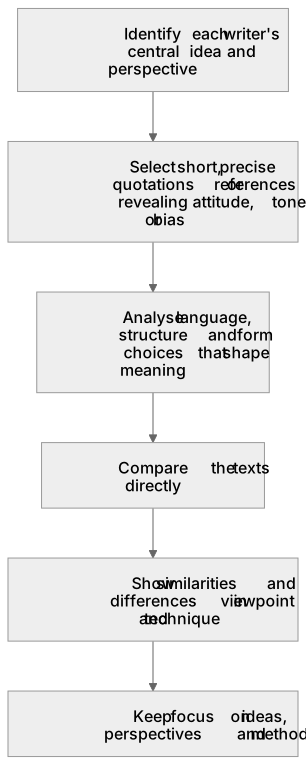
Put it in order
Put these steps in the order they happen.
- 1. Analyse language, structure and form choices that shape meaning
- 2. Select short, precise quotations or references revealing attitude, tone or bias
- 3. Identify each writer's central idea and perspective
- 4. Keep focus on ideas, perspectives and methods
- 5. Show similarities and differences in viewpoint and technique
- 6. Compare the texts directly
Key words
Say what each word means before you turn the card.
Writers’ ideas and perspectives
Try answering aloud or in your head before turning the card.
Comparative analysis
Try answering aloud or in your head before turning the card.
Language and structure
Try answering aloud or in your head before turning the card.
Textual references and evidence
Try answering aloud or in your head before turning the card.
See every definition
- Writers’ ideas and perspectives
- The central idea of each text and the writer’s attitude, bias or emotional stance towards the shared topic, rather than the topic itself.
- Comparative analysis
- Making direct comparative points that explore similarities and differences in both ideas and methods across the texts, rather than describing each separately.
- Language and structure
- The language choices, such as connotation, tone and figurative devices, and structural and form choices, including openings, shifts in focus, paragraphing and genre features, that shape meaning.
- Textual references and evidence
- Short, precise quotations or references, integrated into developed analytical comments, that support the reading of each text.
Label the diagram
Some boxes have lost their names. Pick the right name for each number.
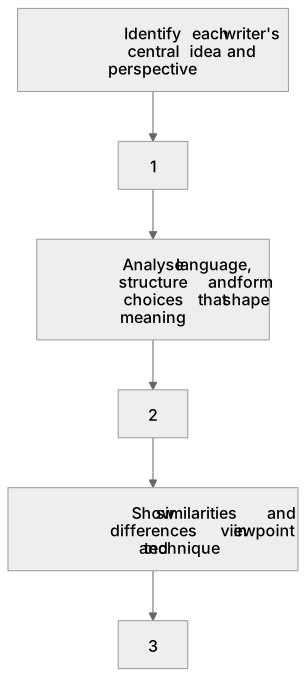
1Box 1
2Box 2
3Box 3
There is more to this lesson
The full lesson goes on to check your understanding and help you earn the marks. Create a free account to carry on, with your progress saved.
A week of Premium from your first lesson · Then the free plan continues · No card, no charge
Test your understanding of Assessment Objectives: AO3: Compare writers’ ideas and perspectives, as well as how these are conveyed, across two or more texts
Active recall beats re-reading. Take an instant quiz now to test what you’ve learned and lock it into long-term memory.
A week of Premium from your first lesson · Then the free plan continues · No card, no charge